IMSI catchers impersonate legitimate cell towers to harvest subscriber identities and intercept communications, and affordable hardware has put them within reach of many threat actors. This guide explains how the attacks work and how enterprise security teams can detect, log, and respond to them.
What Is an IMSI Catcher and Why Does It Target Enterprises?
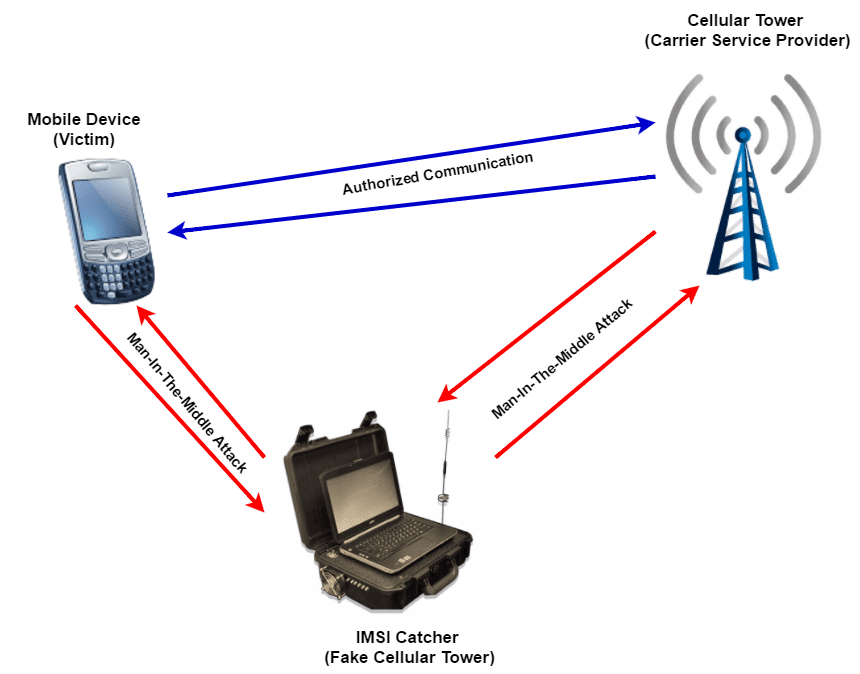
Canadian Centre for Cyber Security (ITSAP) defines IMC catcher as a cell-site simulator which makes your mobile devices its prey by impersonating itself to be an authentic cell tower. 00. 106). These radio frequency systems mimic cellular base stations to discover and record mobile subscriber information, and have become available at a relatively low cost – making them the tool of choice for everyone including nation-states in their technology arsenal. And for enterprise security teams, that change is significant: the risk can no longer be confined to government targets and now intersects with executive protection, deal confidentiality, and operational security.
CATCHERsp;is used by threat actors to gather sensitive information and subsequently modify settings on victim devices. This includes device and user IDs like the IMSI, metadata from voice calls to contacts along with call duration — Content of SMSes and Call Contents (in both cases), as well as data content such as Web sites visited. Common targets include key personnel, executives and anyone in the company who is conducting business operations that involves sensitive information. Typical applications are location and activity tracking, time-and-attendance monitoring for business activities, or targeted surveillance at venues frequented when executives and board members congregate.
Success of an Active IMSI Catcher – they transmit signals on top of, stronger than nearby honest towers — or separate enough in frequency, timing and modulation to be trusted so a phone drops the true connection onto it. Once a device's downlink is dropped to 2G—an older, less secure standard—it can be intercepted with relative ease. Passive Catchers react in the opposite manner. They do not transmit at all, they lurk quietly and passively record cellular broadcast morse codes already afloat in the airways as identifiers fly by. And that silence is what makes them so difficult to detect; there is no glowing signal out in the void, just an invisible listener. That is important because it forms your defense. If you perform an active attack, it will leave detectable anomalies in signalling that can be flagged by monitoring tools; if your collection is passive, however, the device itself leaves almost no trace and rewards environmental-level over handset-level monitors.
| Characteristic | Active Catcher | Passive Catcher |
|---|---|---|
| Broadcasting | Yes—stronger than or impersonating legitimate towers | No—does not broadcast |
| How it operates | Forces devices to disconnect and reconnect to the catcher; can attempt 2G downgrade | Traces and captures transmissions in transit to silently gather identifiers |
| Visibility | Creates observable signaling anomalies | Little on-device evidence; harder to notice without dedicated monitoring |
| Defense focus | Signaling anomaly detection | Environment-level monitoring |
If you are not aware of it, a silent SMS attack is an SMS the device performs without notifying or storing the message on any part of this mobile phone. Since nothing shows up on the screen and there is no sign of it in an inbox, a target has no reason to suspect anything occurred. This allows attackers to use these messages as a very concise way of identifying where the connected device is or send through configuration instructions that could compel the phone to return specific metadata and identifiers back over-the-air. And in one example, a silent SMS may even be used to reprogram the SIM profiles allowing eavesdropping of phone calls and text messages. The stealthy technique is a double-edged sword, which is why it's so dangerous — it can turn an executive's phone into a beacon without the owner ever noticing. It also highlights a more general lesson for enterprises — if the network behavior is abnormal, it needs to be treated as a signal with investigation ensuing and not brushed off as just some random glitch.
How IMSI Catchers Exploit Mobile Networks: Active, Passive and Silent SMS
The exploitation route simply follows the usual attach process. Your phone performs registration and authentication steps when it connects to what is perceived as a legitimate tower, which were designed for trusted networks. A nearby catcher can show a stronger signal, capture the link, and then watch or control what happens next. With IMSI in 2G,3G and the traditional fashion of establishing a connection with the target base station at initial registration — which is precisely when an attacker prefers to capture this information;
Indicate that the protocol version to which they are downgrading their peer is greater than two. This means that an attacker forces a device, which usually connects to 4G or even 5G networks into the containment of using instead a century-old technology in terms of security: They push it down (or simply abuse) the generation must be used and this happens because some kind is either not implemented at all depends on encryption / authentication. Sometimes only a small change in the indicator is given on the device, so many times people do not even realize. Although it does happen from time to time, very seldom – in practice if you see a sudden drop down 2G on what is otherwise strong coverage of 4 and/or 5G signal that will be one the most actionable behavioral signals any enterprise can teach its employees (and their monitoring systems) to look for.
The table below breaks down the main attack styles and shows what each one looks like from the defender's point of view.
| Attack Style | How It Works | Defender Signal |
|---|---|---|
| Active catcher | Broadcasts a stronger or spoofed tower signal to attract devices; may force a 2G downgrade | Anomalous signaling, unexpected downgrades, encryption loss |
| Passive catcher | Does not transmit; captures in-transit transmissions to collect identifiers silently | Little on-device evidence; requires environment monitoring |
| Silent SMS | SMS processed without user notification or storage | Unusual requests for IMSI or IMEI outside normal procedures |
What the table seems to be showing is that no single indicator alone can serve as evidence of an attack. E.g., a sudden fall from 4G or 5G to 2 G, unusual UML data requests (an IMSI or IMEI for example), any base station acting behavior based on out-of-the-ordinary patterns is worth investigating & not conclusive in systems. The most robust conclusions arise from correlating the device anomalies observed to the monitoring data at environmental levels, and (if available) operator data. If we use a security operations center triaging alerts as frame for reference — one suspicious log in might be noise, but an alert where the same account is accessing data from strange geography, on new device fingerprint and with spike access activity points to something much more sinister at once. That layered view is just what distinguishes a mature enterprise mobile security program from one that moves reactively only after an executive has already called in to report an incident.
What Identifiers Are at Risk: IMSI, TMSI, GUTI, SUPI and SUCI
The IMSI is the long-term unique identifier that remains on the SIM and which is often broadcast during first registration in 2G, 3G and 4G: since it does not change over time, leakage of an IMSI can never be completely undone if associated with a person. Temporary Mobile Subscriber Identity (TMSI) and Globally Unique Temporary Identifier(nGUTI):These two identifiers are used by networks to hide the users IMSI as they just give temporary mobile identities. Their utility is completely reliant on operational discipline. The induced privacy benefit collapses if the operators do not rotate them regularly, or use a predictable numbering system; then those temporary IDs can be tracked back to someone.
5G has the introduction of two types of identities called SUPI and SUCI, where we could see that as an encrypted identity which is namely SUCI but also help to view what gathers for HLR. This sounds like a neat fix, however the reality is more complex. For 5G, null encryption is a SSF requirement standard —meaning that SUCI protection will be practically weakened in practice and catchers can still downgrade the mobile network to an earlier version (2 G or 4 G) where there are no such thing as suci at all. So, the key point for enterprise defenders is that 5G improves things at a baseline but does not remove detection and policy need nor user awareness.
This is also where vendor claims deserve careful reading. A detection platform's value is not only in spotting a hostile tower but in how it handles the identifiers and metadata it observes. Enterprises should ask whether a system stores raw subscriber identifiers, how long logs are retained, and who can query them. Those answers determine whether the tool strengthens compliance posture or creates a new data-protection liability that legal and privacy teams will have to manage.
Detection Approaches: Passive Monitoring, Anomaly Analysis and Forensic Logging
Detection tools generally fall into a few families, and the passive-monitoring group is where most enterprises start. Wave Guard Technologies says its Nexus system can locate hostile IMSI catchers and rogue base stations in roughly 30 seconds to a few minutes, running entirely passively across all mobile operators nationwide. Its Tracer component returns polygon query results in seconds, stretching to about two minutes for the heaviest queries, and covers unlimited subscribers. Both run on standard commercial off-the-shelf hardware and operate in accordance with 3GPP, which matters for procurement teams who need gear that fits existing infrastructure rather than a custom appliance. One caveat deserves emphasis: passive detection is not jamming and not blocking. It observes and locates rather than disrupts, so it complements rather than replaces tactical detection assets deployed at a specific site.
GSMK Overwatch, offered via Securemetric, is described as the first solution capable of distributed detection, localization, and neutralization of active attacks on mobile communications via the air interface. A typical deployment includes 100 to 400 stationary sensors for permanent installation at sensitive sites, 10 to 20 quick-deployment sensors for temporary locations, and one central analysis unit at headquarters. Sensors send raw data down to a very low layer, using up to 150 criteria, to the central unit, whose heuristics enable automatic detection around the clock. By design it monitors base station behavior and cannot monitor cellular phones.
Pro-Catcher-Catcher, developed by Prodefence, is built around real-time cellular monitoring: it watches the airwaves continuously to identify emulated network hardware and suppress tactical surveillance threats before they can settle in. The system scans active mobile bands and is designed to neutralize unauthorized base stations in under two minutes, which matters in a threat category where the window between a catcher going live and a device latching onto it can be measured in seconds. Its full-spectrum RF scanning spans 2G, 3G, 4G, and 5G NSA bands, so older low-band protocols are covered alongside current ones—an important detail, since downgrade attacks remain a favored tactic. To verify signal authenticity, it captures and archives System Information Blocks (SIBs), the broadcast messages towers use to describe themselves, giving analysts a way to check whether a given transmitter is what it claims to be. The countermeasures go on the offensive, too: a population attack via fake cellular subscribers and a random access channel attack are used to saturate the catcher's processing resources and disrupt its operation.
For leaner budgets, a Rayhunter-based detector from LaSorsa & Associates is a field-ready option built on open-source Rayhunter technology, using an ultra-portable mobile hotspot as the detector. It detects anomalous cellular signaling, flags unusual requests for IMSI or IMEI outside normal procedures, identifies sudden downgrades from 4G or 5G to 2G or 3G and unexpected loss of encryption or authentication, generates real-time alerts via a local web dashboard, and records diagnostic logs and PCAP files. It is a detection and logging tool, not a mitigator. Cyberkov's IMSI catcher detection services add a service layer: one-time sweeps, event-based sweeps and monitoring, or continuous sweep and monitoring, following a methodology of baseline mapping, scanning, signal analysis, geolocation, alerting, and reporting, with deliverables that include a detection report, cellular threat assessment, rogue station location data, and countermeasure guidance.
Building an Enterprise Defense Program: Coverage, Operators and Alert Tuning
A workable program starts with coverage mapping. Identify the sites that matter most: headquarters, board rooms, executive residences, event venues, and any facility where sensitive operations are discussed. Then decide which of those get permanent sensors and which get quick-deployment kits for temporary use. The GSMK reference architecture of hundreds of stationary sensors plus a smaller pool of portable units is a useful mental model even if your scale is far smaller, because it separates always-on coverage from surge capacity.
Operator coordination is the second pillar. Because catchers exploit network procedures, mobile operators hold data that enterprises do not. Build relationships with carrier security teams in advance, agree on escalation paths, and clarify what evidence they need before they will investigate a suspected rogue base station. Detection data from your sensors becomes far more actionable when an operator can corroborate it, and that corroboration is also what authorities typically require before acting on a report.
Alert tuning is where most programs succeed or fail. Raw anomaly feeds generate noise, and noise breeds ignored alerts. Start with a baseline of normal tower behavior in each location, then tune thresholds around the indicators that matter: unexpected downgrades, encryption or authentication loss, and out-of-procedure identifier requests. Document what each alert means and who owns the response. The research precedent here is instructive: SeaGlass, a University of Washington project from 2017, built sensors from off-the-shelf parts installed in vehicles such as ridesharing fleets, aggregated data over time to create a baseline map of normal cell tower behavior, and detected irregularities. A two-month deployment with 15 ridesharing vehicles in Seattle and Milwaukee identified dozens of anomalies consistent with cell-site simulators, though researchers cautioned they could not definitively attribute them without corroborating evidence. That caveat is the discipline every enterprise program needs.
Limitations, Privacy and Compliance Considerations
No detection technology is unlimited, and any credible program should say so plainly rather than overselling what its sensors can do. Passive monitoring watches the air interface — the radio signaling between handsets and nearby towers — but it cannot look inside encrypted call or data traffic, and it certainly cannot read intent. So when a tool flags an anomaly, that signal is a lead, not a verdict: it might be a misconfigured tower, a carrier's own test equipment, interference from a neighboring cell, or a genuine attack, and only follow-up analysis can tell them apart. It also helps to remember that tools like Rayhunter are logging and detection instruments, not mitigators — they record diagnostic logs and PCAP files and raise alerts, but they do not block or neutralize anything. That distinction matters operationally. A response therefore depends on documented procedures and specialist review, with human judgment applied to each alert, rather than an automated block that could knock legitimate service offline or tip off an attacker.
Privacy cuts both ways here, and it's worth being precise about why. A system that watches how base stations behave is not the same thing as a system that watches people, and the vendors themselves draw that line clearly. GSMK, for instance, describes Overwatch as a defensive system that monitors base station behavior and by design cannot monitor cellular phones. That isn't just marketing language; it reflects an architectural choice about where the sensor sits in the network and what data it is capable of collecting in the first place. Enterprises should insist on that distinction when evaluating vendors, because a tool that can track employee devices opens the door to labor concerns, privacy complaints, and regulatory exposure that can easily outweigh whatever security benefit it delivers. Before any deployment, review how long data is retained, who can access it, and how it is handled across borders.
Market context helps frame budget conversations. Business Research Insights valued the global IMSI catcher market at USD 0.22 billion in 2026 and projects it to reach USD 0.41 billion by 2035. That growth reflects two forces moving at once: defenders are buying more detection and monitoring capacity, and the underlying technology remains cheap and widely available to attackers. For a security leader, the practical conclusion is to treat mobile threat detection as a standing capability rather than a one-off purchase. That means baselining continuously so you know what normal looks like on your networks, tuning alerts as new devices and operators come into play, and rehearsing response so people know what to do when something fires. It also means keeping legal and privacy teams inside the program from day one, because detection data can touch employee communications and personal identifiers, and compliance questions are easier to answer before an incident than after.
What Should an Enterprise Do When an IMSI Catcher Is Detected?
Response begins with preservation. Security teams should preserve forensic logs and PCAP captures, escalate to incident response, and coordinate with mobile operators and authorities. Because detection tools are logging tools rather than mitigators, the response plan must be written before an incident occurs, with named owners, contact lists for carriers and law enforcement, and clear criteria for when to move an executive to a different device or location.
The EFF's 2019 whitepaper remains a useful primer for training staff on the underlying attacks, covering basic IMSI-catcher techniques, communication interception, spoofing authentication, encryption issues, service downgrading, LTE cell-site simulator connection techniques, location tracking, and denial of service. Pair that technical grounding with simple user guidance: report sudden 2G drops, unexpected loss of service in known-good coverage areas, and unexplained device behavior. Trained people plus tuned sensors catch far more than either alone.
How Do IMSI Catchers Work Against Enterprise Phones?
IMSI catchers impersonate a legitimate cell tower and broadcast a stronger signal, causing nearby phones to connect. During the connection procedure the device collects identifiers such as the IMSI, and it can attempt to downgrade the phone to 2G or 4G where encryption and authentication are weaker. Because the phone is behaving as designed, the user typically notices nothing, which is why detection depends on monitoring the radio environment rather than relying on device warnings alone.
What Are the Signs That an IMSI Catcher Is Nearby?
Detection tools flag anomalous cellular signaling, unusual requests for IMSI or IMEI outside normal procedures, sudden downgrades from 4G or 5G to 2G or 3G, and unexpected loss of encryption or authentication. These indicators are evidence for investigation, not proof of malicious intent. Corroborating them with environment-level monitoring, operator data, and physical context is what turns a flag into a defensible finding that incident response and legal teams can act on.
Can Enterprises Detect IMSI Catchers Passively?
Yes. Passive detection observes the cellular environment without transmitting, so a hostile operator receives no warning. Wave Guard Technologies states that its Nexus system locates hostile IMSI catchers and rogue base stations in roughly 30 seconds to a few minutes, operating passively across all mobile operators nationwide. Passive monitoring is not jamming and not blocking, and it complements rather than replaces tactical detection assets deployed at a specific site during a sensitive event.
How Can Enterprises Protect Phones From IMSI Catchers?
Protection combines policy and technology. Keep device software current, enforce strong authentication, and reduce the number of people who carry sensitive information on mobile devices during high-risk travel or events. Deploy passive monitoring at sensitive sites, tune alerts around downgrade and encryption-loss indicators, and rehearse the response plan with legal, IT, and executive protection teams. No single control stops a determined attacker, but layered detection and documented response sharply reduce the window of exposure.
Frequently Asked Questions
How do IMSI catchers work against enterprise phones?
IMSI catchers impersonate a legitimate cell tower and broadcast a stronger signal, causing nearby phones to connect. During the connection procedure the device collects identifiers such as the IMSI, and can attempt to downgrade the phone to 2G or 4G where encryption and authentication are weaker.
What are the signs that an IMSI catcher is nearby?
Detection tools flag anomalous cellular signaling, unusual requests for IMSI or IMEI outside normal procedures, sudden downgrades from 4G or 5G to 2G or 3G, and unexpected loss of encryption or authentication. These indicators are evidence for investigation, not proof of malicious intent.
Can enterprises detect IMSI catchers passively?
Yes. Passive detection observes the cellular environment without transmitting, so a hostile operator receives no warning. Wave Guard Technologies states its Nexus system locates hostile IMSI catchers and rogue base stations in roughly 30 seconds to a few minutes, operating passively across all mobile operators nationwide.
What should an enterprise do when an IMSI catcher is detected?
Security teams should preserve forensic logs and PCAP captures, escalate to incident response, and coordinate with mobile operators and authorities. Detection tools such as Rayhunter are logging tools, not mitigators, so response requires documented procedures and specialist review.
What is an IMSI catcher and how does it work?
An IMSI catcher is a cell-site simulator that impersonates a legitimate cell tower to attract nearby mobile devices. It exploits the normal network attach procedure, capturing subscriber identifiers such as the IMSI during registration. Active catchers broadcast stronger signals or force 2G downgrades, while passive catchers silently capture in-transit transmissions without transmitting themselves.
How can enterprises detect IMSI catchers?
Detection combines passive monitoring, anomaly analysis, and forensic logging. Useful signals include unexpected 2G downgrades, loss of encryption or authentication, and out-of-procedure requests for IMSI or IMEI. Because no single indicator proves an attack, mature programs correlate device-level anomalies with environment-level sensor data and, where possible, corroborating operator information.