Dynamic spectrum management architecture ties sensing, cognition, decision-making and action into a closed loop that adapts spectrum use in real time. Here is how that loop works, where centralized and distributed designs diverge, and what open O-RAN-based systems can and cannot yet deliver.
What Is Dynamic Spectrum Management and Why Does It Matter?
Dynamic spectrum management — also known to some as dynamic spectrum access, where the radio spectrum is assigned based on immediate demand and current network conditions rather than permanently fixed assignment. Rather than setting aside bands as permanent fiefdoms, it allows multiple radio systems to use the same spectrum and maximizes total utilization. It is easy to see the urgency here: global spectrum occupancy measurements have found several licensed bands operating under 15 percent utilization. The difference between what is licensed and what gets used is the dynamic sharing economic case, this gap drives why regulators, carriers and defense users keep coming back to these same architectural challenges.
The traditional alternative is static allocation, which is model driven and relies on expert knowledge + fixed rules. It is legal, predictable and ironclad — but it cannot respond to bursts of demand or unused capacity languishing in an adjacent band. Management has been pushed towards data-driven, real-time allocation by machine learning [19], although the majority of deployed models are specialized for individual tasks leading to weak robustness and limited generalization in rapidly changing environments. However, the communication of agents — i.e. from robotic actors to autonomous vehicles — continues skyrocketing spectrum requirements without being carved out something different for those agents or granting dedicated agent bands
How the Closed-Loop Decision Cycle Connects Sensing, Cognition, Decision and Action
The most valuable one is EISM, embodied intelligent spectrum management which includes a closed loop of embodied sensing/decision making/action; the basic building blocks. The cyclic loop between perception, cognition, decision-making and action allows embodied agents to adapt quickly in time with their environments. In other words, one stage's output is the next's input and the end result refines your next run. The difference between a spectrum conditions dashboard and the system that changes them.
The loop is defined explicitly and gets measured. These indicate what was detected, what a human or an automation decided to do based on that detection and how it changed the run (better/worse) as a result. A closed loop without those four artifacts is really an open loop with wishful thinking. From my experience of reviewing spectrum pilots, the teams that instrument each stage early can be the ones most able to defend their results in front of a regulator or disbelieving incumbent. The teams that do without instrumentation basically get into disputes about anecdotes.
Cognitive management frameworks add a prediction layer to the loop. One method describes sophisticated environment dynamicity by using long-term predictions in conjunction with belief vector, which utilizes knowledge and memory of the surrounding traffic generation behavior. It entails both an analytical study as well as real-time platform implementation in that line of work, since any prediction model which cannot run within the time-frame given for control is worthless operationally. This is then where cooperative spectrum sensing can come into play to provide better input values for the loop, when data fusion or decision fusion are used with multiple sensors being integrated before the stage of committing on a channel.
Centralized vs Distributed DSA Architectures and Their Trade-offs
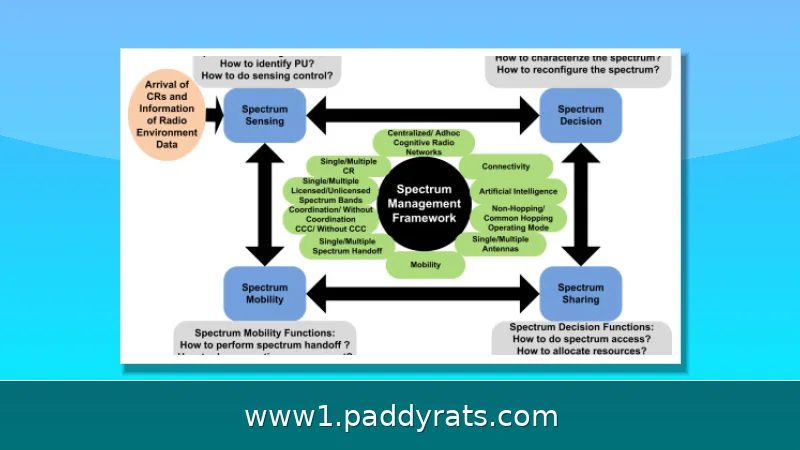
Dynamic spectrum access systems generally fall into two categories: centralized and distributed. Either way, they have to handle the same four jobs: spectrum sensing, spectrum decision, spectrum sharing, and spectrum mobility. The real difference comes down to where the intelligence lives, and that choice has real operational consequences.
| Dimension | Centralized DSA | Distributed DSA |
|---|---|---|
| Decision location | Central controller or spectrum observatory | Secondary users with local coordination |
| Main strengths | Global view, simpler policy enforcement | Lower latency, no single point of failure |
| Main weaknesses | High computational overhead, single point failure, incumbent privacy concerns | Harder to guarantee secure transmit power control |
| Monitoring cost | Dedicated infrastructure, high cost, limited coverage | Relies on device-level or crowdsourced sensing |
< p > Centralized monitoring is likened to creating infrastructure like spectrum observatories which are labored and expensive but offer limited coverage. As an alternative, you have crowdsourcing-based monitoring with portable mobile devices that is traded off in sensor-grade fidelity for reach (or populace). In contrast, it avoids the central bottleneck by performing distributed and secure transmit power control algorithms for secondary users instead; however, this incurs challenge of making guarantee interference count. The incumbent privacy problem impacts both architectures, and that relaxation of the question becomes more relevant if federal or radar systems are in-band.
O-RAN and O-DSM: Open, Virtualized Closed-Loop Spectrum Control
The Open Dynamic Spectrum Management or O-DSM uses the open, standards-based virtualized modular disaggregated architecture of design goals for 5G and also 6G based on a decoupled structure of an radio access network support in architectural layers orchestrating applications where RAN functions are monitored & controlled with AI/ML driven closed-loop controls. The focus-up band is the lower 3 GHz at a working range of between 3.1 and also 3.45 GHz (federal systems in this stretch relocate quickly), Specifically, policymakers have classified this area as essential mid-band spectrum by the Biden-Harris National Spectrum Strategy record; which implies it can be assumed quite effortlessly that stakeholders would certainly like to see others stay out/relocation from their given location so they could remain readily offered! Mobility and national-security sensitivity are precisely where old-fashioned sharing tools fall short of the mark.
The O–DSM work consists of four innovations. 1 AI-based detection and prediction of channel usage under extreme weak signal condition (low SINR) using low-resolution RF data fidelity digital twin of an O-RAN with context-aware closed-loop dynamic spectrum resource control. Finally, a real-time performance, conformity and security test framework with the help of AI-based techniques against industry and regulatory standards. Fourth is a hardware and software prototype that has been tested for 6G coexistence. Each item accounts for a different failure mode, and combined they draw what it really looks like for the stack of spectrum decision making to be closed loop in practice.
Why Do Legacy SAS-Style Sharing Systems Fall Short?
The Spectrum Access System used in the CBRS band works for fixed or slow-moving federal systems, but it shows its limits quickly elsewhere. Operational latency for incumbent sensing and channel evacuation is very high, which is a poor fit for fast-moving emitters. It depends on expensive dedicated Environmental Sensing Capability sensor networks. It lacks context-awareness around weather, diverse traffic types and priorities. It lacks information sharing between incumbents and commercial networks, and it has no intelligent algorithms to speak of. Those are structural gaps, not tuning problems.
That is why the lower 3 GHz case study matters so much. A system built for fixed incumbents cannot simply be sped up; the sensing, prediction and coordination layers need to be redesigned around near-real-time control. O-RAN gives that redesign a standards-based home, with virtualized functions and open interfaces that let AI models plug into the loop instead of sitting beside it.
What Performance Gains and Limits Appear in the Literature?
Reported results are encouraging but should be read with their test conditions attached. A drone-based dynamic spectrum sharing and management study reported 85 percent effective coverage with 125 millisecond decision-making while keeping interference below 12 percent, in a December 9, 2024 preprint. Those numbers describe a specific setup, not a universal guarantee, and the decision latency figure is the one I would watch most closely when mapping the approach onto denser deployments.
Rutgers work on network-assisted dynamic spectrum access offers a second data point. Simulations with overlapping networks of 15 to 35 access points and 50 to 250 clients in a 0.5 by 0.5 square kilometer area showed an average 150 percent improvement in random deployments and up to 7x improvement in clustered deployments for least-performing client throughputs. A graph-based channel selection correction phase showed roughly 30 percent improvement in the number of starved access points at densities of 100 to 500 access points per square kilometer. The team validated the approach on the ORBIT radio testbed with eight-node experiments and extended it with SDN capabilities for wireless control in dense Wi-Fi with multiple operators.
Privacy, Security and Governance Boundaries of the Decision Loop
A closed loop concentrates power, so it needs explicit boundaries. Designs should define what evidence counts, who can approve feedback, and which changes are reversible. Some actions, such as enrichment, deduplication and routing, can run automatically, while higher-risk changes may need human approval. Feedback-source integrity matters just as much, because manipulated tuning inputs can poison the loop and the damage compounds with every cycle. Human-in-the-loop review keeps operators inside otherwise automated workflows, combining automation speed with contextual judgment.
Adaptive management goes one step further by applying learning to recurrent decisions, with double-loop learning updating objectives and framing rather than only parameters. In spectrum work that distinction is practical: tuning a threshold is single-loop, while redefining what counts as harmful interference is double-loop, and the second deserves a governance process rather than a model update. Teams that treat the loop as a measurement discipline, not just an algorithm, tend to survive contact with regulators and incumbents alike.
Frequently Asked Questions
What is dynamic spectrum management?
Dynamic spectrum management, also called dynamic spectrum access, allocates radio spectrum resources based on current demand and network conditions rather than fixed assignment. It lets several radio systems share spectrum and aims to optimize overall utilization, addressing scarcity caused by rapidly growing wireless demand. Worldwide occupancy measurements showing licensed bands below 15 percent utilization are the usual justification.
How does a closed-loop spectrum decision cycle work?
In the embodied intelligent spectrum management architecture, embodied spectrum sensing, cognition, decision-making and action form a closed loop. Through this dynamic loop among perception, cognition, decision-making and action, embodied agents achieve real-time adaptation to environmental changes, feeding outcomes back into the next sensing and decision round. Strong designs also record what was detected, decided and changed.
What are the main spectrum management issues in centralized and distributed DSA?
Both centralized and distributed dynamic spectrum access systems must handle spectrum sensing, spectrum decision, spectrum sharing and spectrum mobility. Centralized designs face high computational overhead, single point failure and incumbent privacy concerns, while distributed designs rely on distributed, secure transmit power control for secondary users and must prove interference limits without a global controller.
Why do legacy SAS-like sharing systems fall short for 5G and 6G coexistence?
Legacy systems such as the CBRS Spectrum Access System have high operational latency for incumbent sensing and channel evacuation, depend on expensive dedicated Environmental Sensing Capability sensor networks, lack context-awareness, lack information sharing between incumbents and commercial networks, and lack intelligent algorithms. That makes them a poor fit for fast-moving federal systems in bands like lower 3 GHz.
What are the main trade-offs between centralized and distributed DSA?
Both centralized and distributed dynamic spectrum access systems handle spectrum sensing, decision, sharing and mobility. Centralized designs offer a global view and simpler policy enforcement but face high computational overhead, single points of failure and incumbent privacy concerns. Distributed designs reduce latency and avoid a central bottleneck, yet rely on secure distributed transmit power control and must prove interference limits without a global controller.
Why do legacy SAS-style sharing systems fall short for 5G and 6G coexistence?
Legacy systems such as the CBRS Spectrum Access System have high operational latency for incumbent sensing and channel evacuation, depend on expensive dedicated Environmental Sensing Capability sensor networks, lack context-awareness, lack information sharing between incumbents and commercial networks, and lack intelligent algorithms. That makes them a poor fit for fast-moving federal systems in bands like lower 3 GHz, where near-real-time control is required.