Faraday bag shielding effectiveness is measured in decibels by comparing signal levels with and without the enclosure, and lab standards like IEEE 299-2006 and MIL-STD-188-125 separate certified bags from wishful thinking. Here is how the tests actually work, what the numbers mean, and how to run credible checks at home.
What Is Shielding Effectiveness and Why Does It Matter?
Shielding effectiveness (SE) is the ratio of unshielded field strength to shielded field strength at the same point, expressed in decibels: SE(dB) = 20 log10 (Ereference / Eshielded). That single formula is the backbone of every serious Faraday bag claim, because it turns a vague promise into a number you can compare across products. When I evaluate a bag, the dB figure tells me far more than any marketing phrase about military-grade protection.
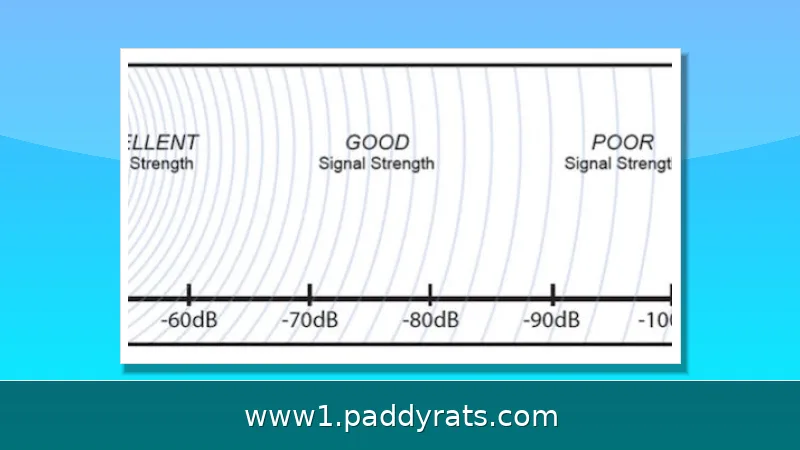
The dB scale compresses enormous ratios into readable numbers. A 60 dB reduction equals 1,000x attenuation, or 99.9% of signal blocked. An 80 dB result equals 10,000x attenuation (99.99%), and 100 dB equals 100,000x (99.999%). Those differences matter because a bag that blocks a strong local Wi-Fi signal may still leak enough energy for a nearby cell tower handshake at a different frequency.
Why it matters in practice comes down to threat models. For key fob relay attacks or forensic phone isolation, you need attenuation across the exact bands your device uses: cellular 700 MHz to 2.7 GHz, Wi-Fi at 2.4 and 5 GHz, GPS at 1.2 to 1.6 GHz, Bluetooth at 2.4 GHz, and RFID from 125 kHz to 13.56 MHz. A single dB number quoted without a frequency range is close to meaningless.
Laboratory Test Methods: Reverberation Chamber and IEEE 299
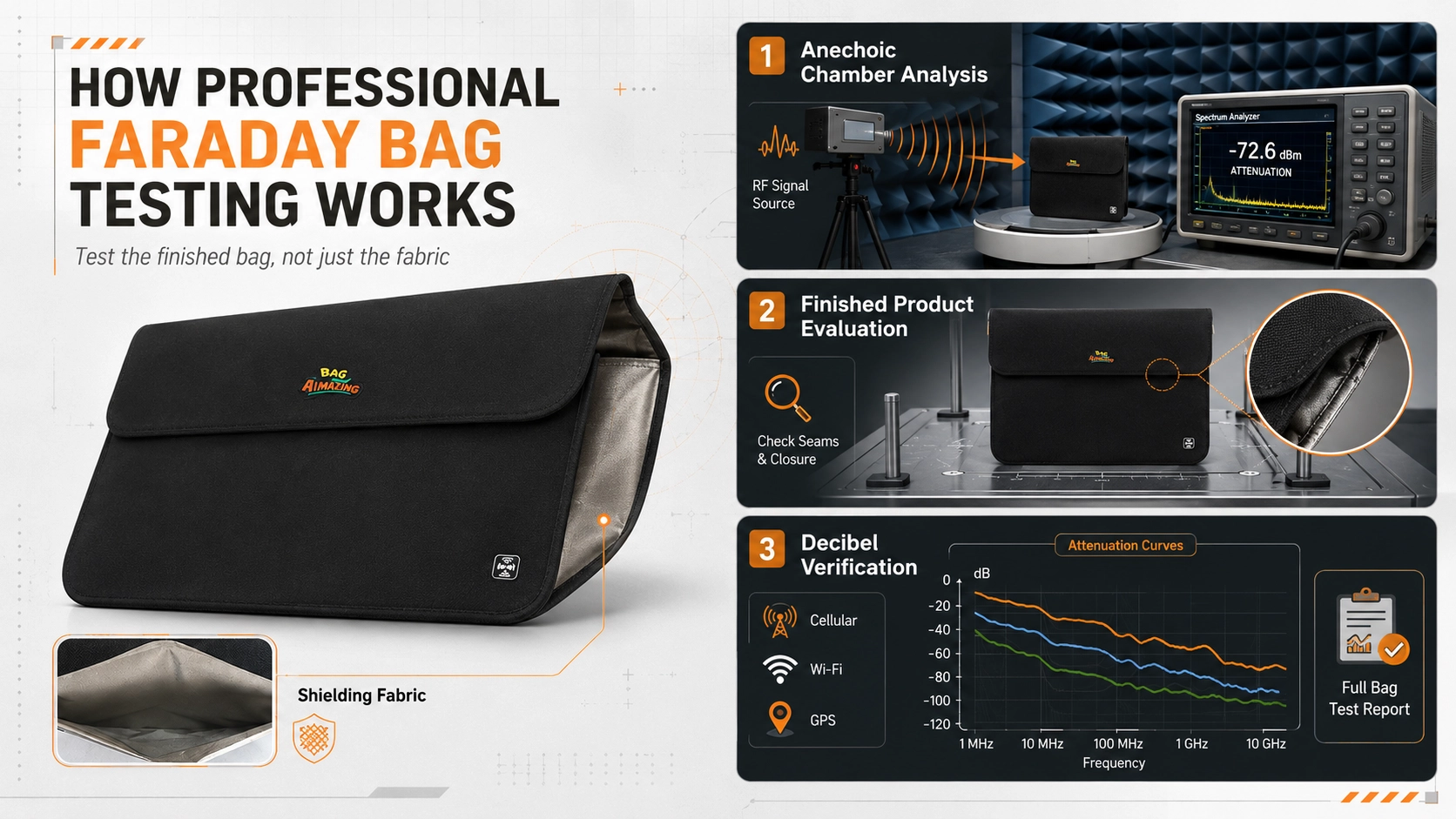
Laboratory testing places a transmitting antenna outside the enclosure and a receiving antenna inside, then records the reference level (bag absent or open) and the shielded level (bag sealed). The difference, run through the 20 log10 formula, is the attenuation. The hard part is creating a repeatable electromagnetic environment, which is why standards exist and why certification costs real money.
IEEE 299-2006 is the primary reference for measuring shielding effectiveness of enclosures, covering 9 kHz to 18 GHz. The standard was written for enclosures larger than 2 meters, so applying it to a pouch requires a lab that understands the scaling problem and documents its setup. MIL-STD-188-125 applies to EMP-grade protection, and MIL-STD-188-125-2 is the citation used for high-altitude EMP hardening. ASTM D4935 handles planar material shielding effectiveness under specified conditions, which is useful for fabric-level claims rather than finished bags.
A mode-stirred reverberation chamber is the workhorse here. Disklabs used a bowtie antenna in a reverberation chamber in its 2014 test, comparing a naked antenna against a shielded one, and its 2016 report used a comb generator as a broadband source with results correlated against a standard mode-stirred chamber at 1 meter. That correlation step is what makes a smaller, cheaper cavity credible rather than merely convenient.
How Do Certified and Uncertified Bags Compare on Paper?
Certification is where the dB conversation becomes commercial. Mission Darkness bags are independently certified to MIL-STD-188-125 and IEEE 299-2006. The Faraday Defense Jacket Pro is certified to MIL-STD-188-125-2 and IEEE 299-2006 and uses triple-layer nickel and copper shielding. Budget pouches such as Simket lack certification, and their attenuation is not proven above 80 dB between 10 MHz and 1 GHz. The table below summarizes the practical gap.
| Product tier | Certification | Documented attenuation | Typical use |
|---|---|---|---|
| Mission Darkness | MIL-STD-188-125, IEEE 299-2006 | Certified across specified bands | Forensics, EMP, high-assurance travel |
| Faraday Defense Jacket Pro | MIL-STD-188-125-2, IEEE 299-2006 | Triple-layer nickel/copper shielding | EMP-grade device isolation |
| Budget pouch (e.g., Simket) | None | Not proven above 80 dB, 10 MHz–1 GHz | Casual signal blocking only |
Read that table as a hierarchy of evidence, not a verdict on build quality. A certified bag proves more than 80 dB attenuation across specified bands under a documented method; an uncertified bag may perform well in your hand and still fail at a frequency nobody tested. If your use case involves evidence handling or EMP, the certificate is the only claim that survives scrutiny.
How to Perform Practical Field Tests on a Faraday Bag
Field tests are convenient but not foolproof, because they measure yes-or-no blocking rather than dB attenuation, and results vary with device, carrier, and proximity to a tower. I still run them, because a bag that fails a phone test has no business holding anything sensitive. Start with the RF meter survey: turn on an EMF or RF meter, place an active phone inside the sealed bag, then sweep the meter around the bag surface and watch for a drop against the baseline reading taken outside the bag.
The cellphone test is the classic. Seal an active phone inside, call it from another line, and note whether it rings. A ring means leakage; silence is a pass, at least for that band and that carrier's signal strength. The key fob test works the same way: operate a car remote from inside the bag near the vehicle, and no response indicates shielding at the fob's frequency. A Bluetooth speaker or Wi-Fi connection test gives you a quick read on 2.4 GHz and 5 GHz behavior.
Treat every field result as a lower bound. None of these methods produce a dB figure, and a bag can pass a phone test while leaking at GPS or RFID frequencies. When I want proof rather than reassurance, I look for third-party lab certification to IEEE 299-2006 or MIL-STD-188-125, and I treat a 2022 SLNT test video or a vendor blog post as marketing context rather than data.
What dB Attenuation and Frequency Range Should You Look For?
A good shielding effectiveness figure for a Faraday bag starts around 80 dB across the bands you actually care about, with 60 dB as a floor for casual use and 100 dB reserved for demanding EMP or forensic scenarios. The number is only meaningful when paired with a frequency range and a test method. A claim of 80 dB with no stated band is a red flag, and a claim of 120 dB from an uncertified seller deserves skepticism.
Match the range to your devices. Cellular spans roughly 700 MHz to 2.7 GHz, Wi-Fi sits at 2.4 and 5 GHz, GPS occupies 1.2 to 1.6 GHz, Bluetooth is at 2.4 GHz, and RFID runs from 125 kHz to 13.56 MHz. A bag certified only at 1 GHz tells you little about 5 GHz Wi-Fi or low-frequency RFID. Ask for the test report, not just the badge on the product page.
What Are the Common Failure Points and Maintenance Tips?
Most failed shielding tests trace back to the closure. A Faraday bag works only as a complete, unbroken conductive enclosure, so an improperly sealed flap, a gap at the fold, or a partially closed zipper creates an aperture that leaks. Inspect seams for poor construction, look for tears and punctures in the conductive fabric, and check for worn metal mesh. Replace damaged bags rather than patching them.
Maintenance is mostly discipline. Ensure the closure is fully sealed every time, store the bag away from sharp objects, and re-test periodically with a phone or RF meter if the bag sees hard use. Wear reduces performance gradually, and a bag that passed a year ago may not pass today. No bag is 100% foolproof, and effectiveness varies by frequency and construction, so pair a certified bag with a habit of verifying it.
Frequently Asked Questions About Faraday Bag Testing
The questions below come up constantly in forums and in my own inbox, and the answers track the standards and methods covered above. They are written to be quoted directly, whether you are comparing products or explaining the topic to a colleague.
If a seller cannot answer which standard was used and over what frequency range, assume no meaningful test was performed. That single question filters out most of the noise in this category.
Frequently Asked Questions
What is the standard test method for Faraday bag shielding effectiveness?
IEEE 299-2006 is the primary reference for measuring shielding effectiveness of enclosures, covering 9 kHz to 18 GHz. MIL-STD-188-125 applies to EMP-grade bags, and ASTM D4935 defines planar material shielding effectiveness. Labs compare the received signal with and without the bag to calculate attenuation in dB.
How is shielding effectiveness measured in decibels?
Shielding effectiveness is the ratio of field strength without the shield to field strength inside the shield, expressed as SE(dB) = 20 log10 (Ereference / Eshielded). A 60 dB reduction means 1,000 times less signal power, or 99.9% blocked. Higher dB indicates better attenuation.
Can I test my Faraday bag at home with a phone?
Yes. Simple field tests include placing a phone inside a sealed bag and calling it, or checking Wi-Fi and Bluetooth disconnection. These tests are not foolproof because they do not measure dB attenuation across frequencies. For reliable proof, look for third-party lab certification to IEEE 299-2006 or MIL-STD-188-125.
Why do some Faraday bags fail shielding tests?
Common failure points include improperly sealed closures, gaps or tears in the conductive fabric, poor seam construction, and low-quality metal mesh. The bag must form a complete, unbroken conductive enclosure. Regular inspection and proper sealing are essential for maintaining shielding effectiveness.