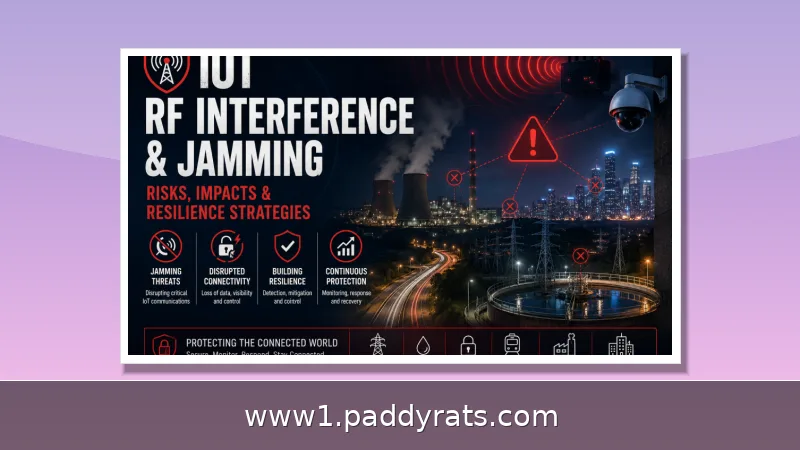
A jammed IoT sensor doesn't report an error—it reports nothing, which is exactly the failure mode cloud monitoring is blind to. Resilient telemetry therefore has to be engineered below the application layer, with redundant bearers, sub-second hot-standby switching, and detection that treats silence as a signal.
Why Does Jamming Turn IoT Telemetry Into Silence?
The first thing I tell anyone building a sensor network: jamming looks like a connectivity problem, but what it really takes away is availability. A jammer floods the channel with noise, overpowers it, or throws in interference patterns until the receiver just can't decode what shows up. The device itself is usually fine, and it has no clue anything is wrong, so the telemetry never makes it out of the radio. What you get is missing data, not a red metric on a dashboard. And most cloud monitoring is built on the assumption that telemetry shows up right on schedule.
This is where the design usually goes wrong. Application-layer monitoring looks for values that seem off, but a jammed node doesn't send any values at all. So if your alerts only fire on out-of-range readings or explicit error codes, a denial-of-service attack against the wireless link can go unnoticed until someone happens to spot a gap by hand. Resilience has to sit below the application: in the radio layer, the network layer, and the routing logic that picks which path carries the next packet.
How Do Jamming Attacks Disrupt Sensor and Control Traffic?
Jamming isn't a single technique. An attacker might go after one frequency, a whole band, or a protocol-specific pattern like a preamble or header. Behavior matters too: constant jamming floods a channel nonstop, whereas reactive jamming sits quiet until it detects a valid signal, then transmits—disrupting packet delivery while keeping the attacker's exposure and power draw low. Deceptive and random variants make the same kind of trade, sacrificing reliability for stealth. And frequency targeting comes in three flavors—barrage, spot, and sweep—each leaving a different signature on a spectrum analyzer.
The damage isn't limited to a few missing readings. Jamming can also cut into authentication exchanges, silence telemetry, hold up control commands, and break the coordination that distributed devices depend on. That last one is the real worry for safety-critical deployments: when the link carries control or credential traffic, a disruption can leave operators blind for a while or push systems into weaker fallback behavior. It helps to think in terms of intentional electromagnetic interference, too, since the physics works the same whether the source is an adversary, a faulty transmitter, or plain co-channel congestion. And the EASA–EUROCONTROL joint action plan from March 2026 said this out loud for aviation, treating interference as a condition to design around rather than something anyone can eliminate.
Which Radio Bearers Are Exposed: Cellular, NTN, LoRaWAN, and GNSS?
Each type of radio link comes with its own risk profile, and treating them as interchangeable is exactly how teams end up with redundant links that fail together. Licensed cellular is legally protected and monitored by the operator, but a strong enough jammer at close range can still knock it out physically. Satellite and non-terrestrial network links arrive faint from orbit, so weak-signal exposure is baked in by definition. LoRaWAN runs in unlicensed ISM bands — 868 MHz in the UK and EU — sharing a contention-based space with no exclusivity, and published research shows that both deliberate low-cost jamming and accidental co-channel interference degrade it.
GNSS is the cautionary tale here. Aviation reporting counted well over 120,000 flights affected by GNSS interference in just the first four months of 2025, and around Vilnius, pilots reported more than 800 interference cases in Q4 2024 — versus 124 in the same period a year earlier. Finnair suspended flights to Tartu, Estonia in 2024 after repeated outages made landings impossible, and in September 2025 a flight carrying the European Commission president was disrupted over Bulgaria. The uncomfortable part for IoT: plenty of devices lean on GNSS for time and position, so a GNSS denial can quietly corrupt timestamps long after the link itself comes back.
What Are the Failover Building Blocks for Jamming Resilience?
Failover means switching from a primary channel to a backup when the primary one fails, and the actual mechanics are a lot less glamorous than vendor marketing makes them sound. You need redundancy across multiple cellular networks, Wi-Fi, and protocols. You need automatic detection that actually works, which means watching for lost packets, timeouts, and missed heartbeats rather than assuming the link is fine because nobody complained. The transition itself has to be seamless, reconnecting and resuming transmission without dropping the session. Then there's priority logic, spelled out explicitly, like cellular first, then Wi-Fi, then a second cellular provider. You'll also want load balancing across paths, health monitoring of the backups themselves (a backup nobody checks is just a rumor), remote configuration management, and regular testing, so you don't find out the backup is dead in the middle of an actual jamming event.
Below is the checklist I actually run through when auditing a deployment. For each item, I've noted the failure it's meant to catch.
Which Failover Controls Cover Which Failure Modes?
| Control | Failure It Catches | Practical Note |
|---|---|---|
| Multi-bearer redundancy | Single-band jamming | Mix licensed cellular, Wi-Fi, and LPWAN rather than two carriers on one band |
| Heartbeat and timeout detection | Silent node loss | Set timeouts below the operational tolerance, not below the reporting interval |
| Hot-standby interfaces | Slow re-association | Pre-authenticate backups so switching is a routing change, not a handshake |
| Priority and routing logic | Wrong-path selection | Define the order explicitly and log every switch |
| Backup health monitoring | Dead backup link | Test backups continuously, not just at commissioning |
| Local buffering and safe mode | Extended outage | Preserve data and avoid insecure bypass behavior |
What stands out here is that most of these controls are cheap to implement and almost never tested. Redundancy without health monitoring is basically theater. Priority logic without logging leaves you with no forensic trail when something goes wrong. Safe-mode behavior deserves its own callout, too: a device that responds to jamming by disabling authentication or falling back to a default configuration has just turned an availability incident into a security incident.
How Fast Can Network-Layer Failover Restore Telemetry?
This is where measured numbers beat vendor claims. A ROS 2 mobile robot testbed kept dual pre-authenticated physical interfaces in hot standby and performed instantaneous failover through automated network routing table updates. When a jamming event was declared, outbound telemetry and control traffic were redirected by modifying the Linux default route. Communication recovered in an average of 141 ms, and that sub-second restoration produced a 78.9% reduction in pooled root-mean-square path tracking error compared with software re-association.
The lesson generalizes well beyond robots. Software re-association means tearing down and rebuilding a connection, which can take seconds and lose state. Hardware-assisted failover with pre-authenticated interfaces turns the problem into a routing decision, and routing decisions are fast. For sensor telemetry, the same principle applies: keep the backup path warm, authenticated, and addressable, so the switch is a table update rather than a negotiation. Cross-technology anti-jamming schemes point the same direction, delivering 78% of goodput with a cross-technology jammer present and outperforming passive and random anti-jamming approaches.
How Is Jamming Detected in Wireless Sensor Networks?
Detection is pattern recognition against a noisy baseline. The signals that matter include packet delivery ratio dropping, RSSI or signal strength anomalies, rising bad packet ratio, carrier sensing time showing a channel that is constantly busy, irregular packet inter-arrival times, spectrum analysis, and machine learning classifiers trained to separate smart jammers from ordinary congestion. Adaptive cluster-based LoRa-BLE mitigation combines packet delivery success rate with RSSI variation and dynamically switches protocols to cut retransmissions and save energy.
In practice, I would not rely on a single indicator. A busy channel with normal packet inter-arrival times looks like congestion; a busy channel with collapsing delivery ratio and rising bad packet ratio looks like jamming. The combination is what gives you confidence, and confidence matters because false positives trigger unnecessary failovers that cost power and bandwidth. Baseline your normal behavior first, then set thresholds against that baseline rather than against generic defaults.
What Mitigation Controls and Compensating Measures Actually Help?
Mitigation splits into radio-level and system-level measures. At the radio level, frequency hopping, power control, directional antennas, channel switching, jammer localization, and adaptive protocols all help, and encryption with authentication protects the traffic that does get through. At the system level, the compensating controls are often more effective: alternate frequencies, physically relocating gateways, stronger site monitoring, safe-mode behavior, local buffering, and wired alternatives where the environment allows them.
One caution deserves its own paragraph. Jamming can mask concurrent intrusion or unauthorized device behavior, so recovery should include a compromise review rather than a simple all-clear. LoRaWAN has practical limits that help defenders, including frequency hopping and long sensor distances, but attack vectors should be considered as the technology matures and low-cost jamming hardware becomes more accessible. The goal is not a link that cannot be jammed. It is a system that notices silence quickly, switches paths automatically, preserves data locally, and refuses to trade security for availability when the pressure is on.
Why Does Cloud-Style Monitoring Miss Jamming?
Cloud monitoring is excellent at what it was designed for: watching metrics that arrive. It is structurally blind to the absence of metrics unless you explicitly build gap detection. A practical playbook, similar in spirit to the Datadog monitoring guidance many teams already follow, treats missing heartbeats as a first-class alert, tracks expected-versus-observed reporting intervals, and correlates gaps across nodes to distinguish a single dead sensor from a regional radio event. Correlating across nodes is the key step, because one silent device is a device problem and twenty silent devices in one geography is a jamming problem.
Why does a jammed IoT sensor go silent instead of reporting an error?
A jammed device cannot get its telemetry through the radio link, so it sends nothing at all rather than an error message. Cloud-style monitoring assumes telemetry arrives; when the radio layer is denied, the failure mode is absence, not a red metric, so resilience must be designed below the application.
What does failover mean in an IoT deployment?
IoT failover is the ability to switch from a primary communication channel or network to a backup channel when the primary fails. It relies on redundancy, automatic detection of lost packets or timeouts, seamless transition, channel priority logic, health monitoring of backups, and regular testing.
How fast can network-layer failover restore telemetry under jamming?
In a ROS 2 mobile robot testbed using dual pre-authenticated interfaces in hot standby with automated routing table updates, communication recovery averaged 141 ms. That sub-second restoration produced a 78.9% reduction in pooled root-mean-square path tracking error versus software re-association.
How is jamming detected in wireless sensor networks?
Detection uses packet delivery ratio drops, RSSI or signal strength anomalies, rising bad packet ratio, carrier sensing time showing a constantly busy channel, irregular packet inter-arrival times, spectrum analysis, and machine learning models that classify smart jammers. Adaptive schemes combine delivery success rate and RSSI variation.
Frequently Asked Questions
Why does a jammed IoT sensor go silent instead of reporting an error?
A jammed device cannot get its telemetry through the radio link, so it sends nothing at all rather than an error message. Cloud-style monitoring assumes telemetry arrives; when the radio layer is denied, the failure mode is absence, not a red metric, so resilience must be designed below the application.
What does failover mean in an IoT deployment?
IoT failover is the ability to switch from a primary communication channel or network to a backup channel when the primary fails. It relies on redundancy, automatic detection of lost packets or timeouts, seamless transition, channel priority logic, health monitoring of backups, and regular testing.
How fast can network-layer failover restore telemetry under jamming?
In a ROS 2 mobile robot testbed using dual pre-authenticated interfaces in hot standby with automated routing table updates, communication recovery averaged 141 ms. That sub-second restoration produced a 78.9% reduction in pooled root-mean-square path tracking error versus software re-association.
How is jamming detected in wireless sensor networks?
Detection uses packet delivery ratio drops, RSSI or signal strength anomalies, rising bad packet ratio, carrier sensing time showing a constantly busy channel, irregular packet inter-arrival times, spectrum analysis, and machine learning models that classify smart jammers. Adaptive schemes combine delivery success rate and RSSI variation.